
From the community bulletin board to the AI-powered event calendar the question of how to market and promote community events has been a puzzle for at least a century. Events were once posted on a bulletin board at the post office, in the local newspaper, on a flyer pinned to a storefront window, or in chamber of commerce newsletters.
Then came the website and social media networks. That was followed by online event platforms and sophisticated calendar-management software. Each evolutionary step improved the way events could be presented. But there remained a problem.
The world changed faster than the event calendar did and today a community may have hundreds of events listed across dozens of organizations and platforms. Information is scattered among websites, Facebook pages, ticketing services, newsletters, Google calendars and social feeds. But the biggest issue is an age old problem. The traditional event calendar still waits for somebody to find those events and enter them. Yodel takes a fundamentally different approach. That difference is at the heart of the next generation of community event calendars.
Changing Times
The community calendar is hardly a new invention. Before the internet, newspapers were often the community’s information clearinghouse. A newspaper’s calendar, entertainment section or classified advertisements would informl residents about concerts, civic meetings, festivals, theater performances, church suppers, sporting events and public gatherings.
This model was straightforward. Someone supplied the information and an editor organized it. Then came the web.
Organizations began creating their own event pages. Chambers of commerce, convention and visitors’ bureaus, municipalities, newspapers and Main Street organizations could publish events without waiting for the next newspaper edition. That was a major improvement.
Then came social media. Facebook events, Instagram posts and other social platforms made publishing an event remarkably easy. But they also created a new problem: information became fragmented.
Chaos
An event could be announced on Facebook but never submitted to the official tourism calendar. A festival might appear on a city’s website but not on the chamber’s calendar. Meanwhile a concert might be promoted on Eventbrite or Ticketmaster while remaining invisible to the community’s official event page.
It was never easier to publish an event. But it was never harder for a community to know everything that was happening. The community calendar had been moved from the bulletin board to the web. Problems were solved, and problems were compounded.
The next generation of calendar technology was created to solve this problem. Platforms such as Localist and Trumba brought sophisticated tools to event management. Both platforms were widely implemented by universities, healthcare systems, and government organizations to centralize, schedule, and promote large volumes of events. These platforms represent an important evolution of the event calendar.
A Digital Age
The calendar moved from a static webpage toward a more interactive and manageable digital product. But there remains a fundamental distinction between managing events and discovering events. This is where Yodel enters the picture. Most conventional event calendar systems are built around a familiar workflow: Submit → Review → Approve → Publish → Update
Yodel approaches the problem from another direction: Discover → Aggregate → Clean → Structure → Publish → Update
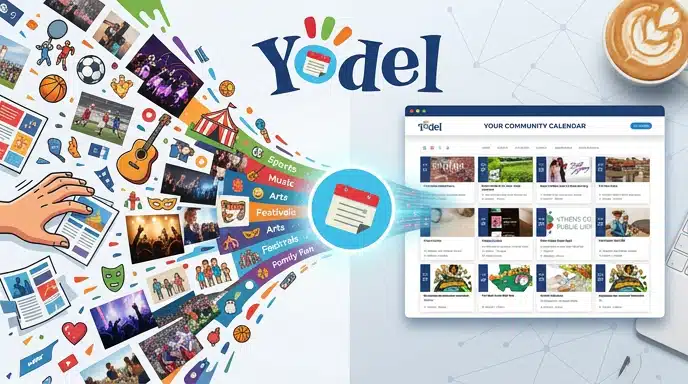
It is designed to discover local event information from websites, social media, event platforms and calendar feeds, then organize and continuously update that information. Connected sources can include websites, Facebook pages, Eventbrite, and Ticketmaster feeds. That is more than an incremental improvement. This changes the role and impact of the event calendar.
Blurring The Line
The older model works beautifully. So did the community bulletin board. But only when there are relatively few events and someone has plenty of time. But as a community grows, the workload grows with it.
It requires staff to correlate submissions, enter information, correct mistakes, update dates, remove expired events and look for events that never get submitted. Yodel’s eliminates much of that repetitive work by automatically discovering and updating event information. This approach is specifically designed around turning event information into structured, discoverable content rather than allowing events to disappear into social feeds. That is important for SEO.
The community calendar began as a way of connecting neighbors and strengthening a sense of community. Technology made it possible to reach a much larger audience. But technology also fragmented the information. Yodel brings the pieces back together.
Yodel combines automated discovery, data organization, continuous updating, customizable presentation and integration with existing websites and applications. Organizations determine what they want to showcase, while Yodel handles the repetitive work required to keep the information flowing.
Written by Jim Hinckley’s America