From event calendar to revenue engine. For generations, the community event calendar was a deceptively simple idea. Just tell people what is happening, when it is happening, and where to find it. The trouble is that the traditional event calendar rarely lived up to that promise. And it seldom was developed as a revenue stream.
First, someone must collect the information. Then someone must enter it, someone must check whether the date has changed, and someone must remove events after they happen. And then someone eventually gets the inevitable phone call. That old-fashioned calendar concept is not really a marketing tool. And for most of the past 25 years the event calendar became a part-time job disguised as a webpage.
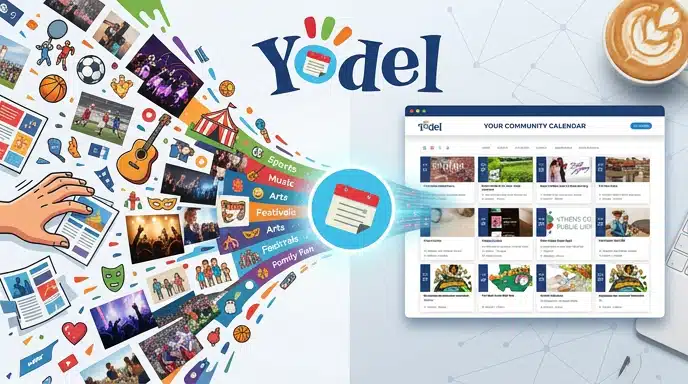
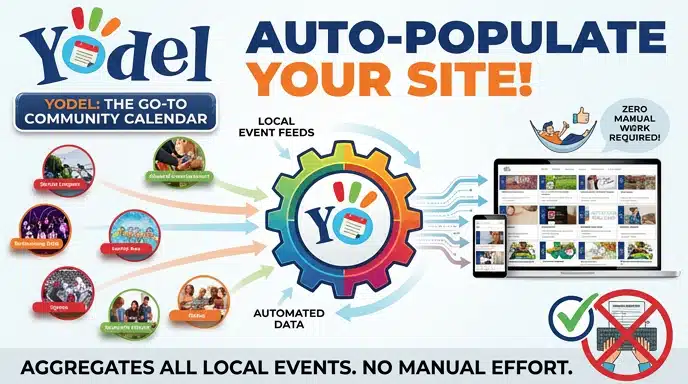
Yodel uses artificial intelligence to discover, organize, structure and continuously update local event information. That creates an “Event Cloud” for local events. Rather than depending entirely upon people to submit and maintain listings, Yodel can draw information from sources such as websites, Facebook pages, Eventbrite, Ticketmaster and calendar feeds. That creates a much more comprehensive and continually refreshed calendar. And that transforms the event calendar into a revenue engine.
From Event Calendar to Revenue Engine
That seemingly simple change opens the door to something much bigger. The community event calendar can become a destination marketing tool. It has also been transformed into an SEO engine, a community-building platform and a revenue stream.
The traditional calendar depends upon manual labor. A chamber of commerce, convention and visitor’s bureau, Main Street organization, newspaper, or tourism office may have dozens or even hundreds of organizations producing events. Festivals, concerts, farmers markets, museum programs, car shows, historic celebrations, theater performances, charity events, sporting activities and business promotions fill weekends. But does their listing on an events calendar translate to revenue stream?
Yet only a fraction of events ever make it onto the community’s official calendar. Only a few are updated when things change. Why? Because somebody must find them and ensure accuracy. Yodel approaches this problem differently. Its technology continuously gathers event information from multiple sources and refreshes listings, while allowing organizations to establish rules for the kinds of events they want to feature. The result is a fundamental shift from event calendar to revenue engine dynamo.
More Than an Event Calendar
A truly effective event calendar answers a much bigger question Why should I visit this community?
An accurate and current event calendar can lead a traveler searching for a weekend festival to discover a historic downtown. Someone looking for a concert may discover a museum or a family searching for children’s activities may discover a farmers’ market. A Route 66 traveler looking for something to do on Saturday night may discover that the community has enough attractions, restaurants, shops and events to justify staying another night. That is where calendars become powerful tools for destination marketing and economic development.
Yodel specifically positions its calendar for tourism bureaus, chambers of commerce, Main Street organizations, news organizations and community applications. Its tourism model is built around showcasing festivals, markets and other local happenings while encouraging visitors to remain engaged with the destination website. Simply put, the calendar becomes the community’s front door. And once people walk through that door, there are opportunities to introduce them to the rest of the community.
The Importance of SEO
Search engines thrive on useful information. A static calendar containing a few manually entered listings has limited potential. But a continuously refreshed event calendar creates substantially more opportunities for a website to become relevant to the questions people are asking.
Yodel’s calendar is an SEO-driving content engine. Refreshed event information can increase engagement and help visitors discover additional destination content. The objective is to create genuinely useful content that people are already searching for and enhance SEO. If someone searches for “things to do in Kingman, Arizona this weekend” and finds a comprehensive, current event calendar, the website has accomplished something far more valuable than simply generating a page view. A conversation began with a potential visitor.
So, what happens when an event calendar becomes one of the most frequently visited sections of a community website? Could this transform the event calendar into a revenue stream?
Unleash The Imagination
A local bank, hospital, automobile dealership, hotel or regional business could sponsor the calendar. That sponsor receives consistent visibility while the community gains a potential source of non-dues revenue. Yodel provides the opportunity for advertising and sponsorship revenue within highly engaged calendar pages. That means the event calendar isn’t merely something a visitor uses and leaves. It can become an advertising environment that also adds a revenue generating component. .
And unlike a random banner on a website, calendar advertising can be highly contextual. A visitor looking at a calendar full of festivals and weekend activities is already thinking about where to go, what to do and how to spend their time.
That becomes an opportunity for a hotel, or a restaurant, or an attraction. Consider the possibilities. Unleash the imagination.
The All Important Event Calendar
This advertising calendar is particularly significant for organizations that need to diversify revenue. Chambers of commerce are increasingly looking for non-dues revenue opportunities. Main Street organizations and downtown associations frequently operate with limited resources. Tourism organizations are constantly asked to demonstrate measurable value.
A well-developed event calendar offers all three organizations another asset to monetize. Imagine the potential when a chamber offering a membership package includes enhanced event visibility. Or a downtown merchants organization selling sponsorships for its “What’s Happening Downtown” calendar.
Yodel’s system is designed to gather event information at scale rather than relying exclusively upon manual submissions. It’s intended to provide a continuous stream of structured local event data that can serve websites, destinations, publishers and applications. The future isn’t about having a better calendar. It is about creating a better community information ecosystem. The Yodel powered event calendar can become the connection that links residents, businesses, attractions, nonprofits, tourism organizations, media and visitors.
This is where the traditional bulletin-board calendar ends and the modern destination marketing platform begins. Yodel provides the technology to automate discovery and curation. The community provides the stories, places, people and experiences that make those events meaningful. Together, they create something considerably more valuable than a list of dates.
Written by Jim Hinckley’s America