For decades, communities have chased the same promise. They want to develop a single, reliable place where residents and visitors can find out what’s happening. Chambers of commerce, tourism bureaus, Main Street programs, downtown associations, and destination marketing organizations have all tried to build it. And yet, despite the introduction of countless software platforms, plugins, apps, and social feeds the problem hasn’t been resolved. It has multiplied.
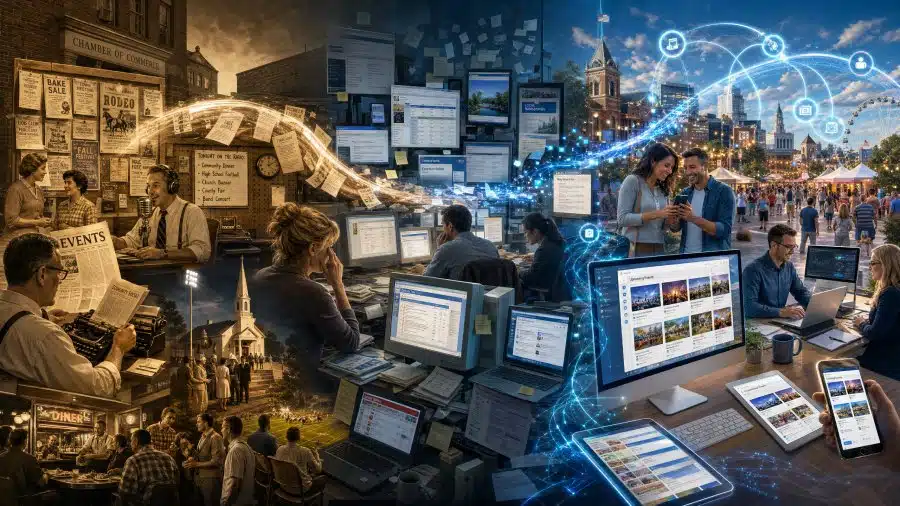
Today’s event ecosystem is more active than ever, but also more fragmented, more inconsistent, and more labor-intensive than at any point in history. Most “solutions” don’t solve the problem. They simply shift the burden, fix one aspect and magnify problems with others, and are still labor intensive. That’s where Yodel changes the equation. Most community calendar systems were designed for a simpler world. One organization submits events and a staff member approves listings. A website displays a monthly calendar, and residents check one central source. That model broke the moment the internet expanded event promotion into thousands of disconnected channels.
Why Yodel Outperforms Traditional Event Calendar
Now events listings are fractured. They are found on Facebook pages, Instagram posts and business websites. School district calendars are occasionally intertwined with those on library websites. Tourism listings are shared through websites, newsletters, and third-party event platforms. No single organization controls the full picture anymore. And that’s the fatal flaw of traditional platforms as well as software platforms. They each depend on humans manually feeding them information.
If someone forgets to submit an event, it doesn’t exist in the system. Or if a date changes, it’s often never updated. And if a festival is announced on social media only, it never reaches the official calendar at all. As one industry analysis puts it, most platforms still assume “someone will push data in,” which guarantees incomplete coverage.
Almost every traditional calendar platform still relies on the same workflow. “Submit your event here.” It sounds simple. It isn’t. Because the burden is placed on the very people least likely to maintain it from volunteers running nonprofit fundraisers, small business owners juggling operations, and tourism partners managing multiple channels. The event calendar becomes a breakdown loop. Organizers forget to submit events and so calendars appear incomplete. Then users stop trusting the calendar and fewer people check it, even fewer organizers submit event information. The result is a self-defeating system where adoption collapses under its own friction. In other words, the more a platform depends on participation and manual input the less it gets.
Social Media
Initially social media looked like a solution. The reality is that it magnified the fragmentation problem.
Events are posted in feeds that disappear within days and algorithms hide local content from most followers. Information is scattered across platforms and pages, and there is no standardized structure for dates, locations, or categories. Even worse, social posts do almost nothing for long-term discovery. They don’t build searchable archives or integrate into civic systems, and they don’t feed tourism planning tools. As a result, a community might have hundreds of events happening. But only a fraction ever becomes visible in an official calendar. The rest are simply buried in the feed.
Many platforms improved design, added mobile support, or introduced submission portals. But structurally, most still suffer from the same weaknesses including manual entry dependency, fragmented data sources, and incomplete coverage. Even newer tools that improve user experience still fail to solve the foundational issue. They are little more than passive systems in an active, chaotic environment.
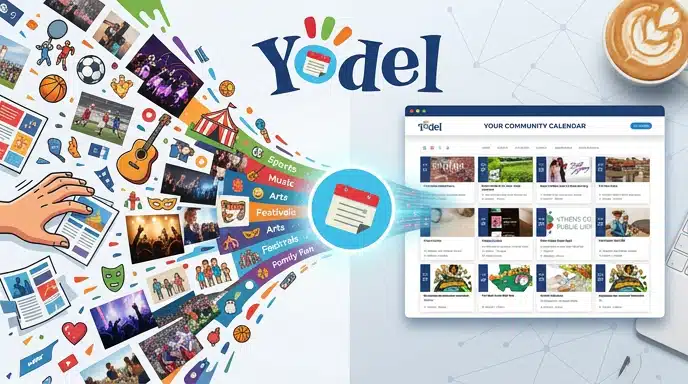
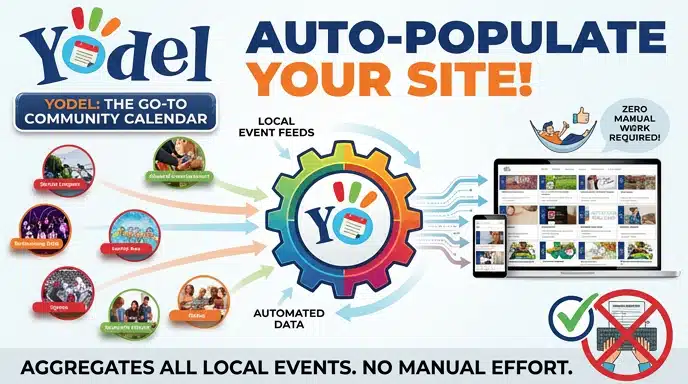
Yodel was built on a different assumption. A modern community calendar should not depend on humans chasing information. It should discover it. Instead of waiting for submissions, Yodel actively gathers event intelligence from across the digital ecosystem. Then it organizes, standardizes, de-duplicates, and structures that data into a unified, searchable calendar system. The result is not just a calendar. It is a continuously updated community support system.
Yodel structures event data so it can be found in an orderly manner without time consuming searches. That turns calendars into tourism and economic development engines, not just listing pages.
Even strong event software platforms tend to stop at one stage of the problem. Some focus on submission tools, display design, ticketing integration or social sharing. But they don’t address the full event calendar lifecycle: Discovery → aggregation → cleaning → structuring → publishing → updating → redistributing
The Break Down
That end-to-end gap is where most systems break down. Yodel closes that gap. With Yodel AI event calendar curation becomes an economic development engine.
A well-built event calendar is no longer just a convenience tool. It is key to tourism development, generating traffic in the historic business district, and a marketing platform. It is a powerful tool for building stronger communities.
Traditional event calendar systems were built for a world that no longer exists. They are locked in the past where information was centralized, slow-moving, and manually maintained. That world is gone. Today’s communities need something fundamentally different. They require a system that sees more, processes faster, updates continuously, and reduces manual effort instead of multiplying it. That is where Yodel stands apart.
Yodel is not merely another calendar tool. It is a complete rethinking of how community life is discovered, organized, and shared. Because in the end, a great community isn’t defined by what happens.
It’s defined by how easily people can find it.
Written by Jim Hinckley’s America