
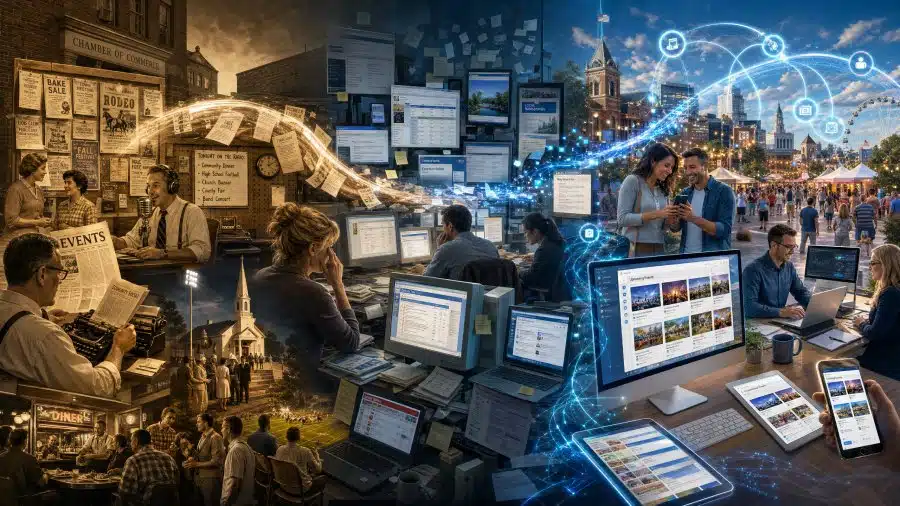
From bulletin boards to brainpower the story of how event calendars evolved is an interesting and relevant story. There was a time when finding out what was happening in required thumbing through the local paper, tuning into the local radio station, or checking out the bulletin board at the chamber of commerce.
In the local newspaper event information was squeezed between church bake sales, Little League signups, and the occasional ad for discounted mufflers. If you missed the weekly paper, you missed events that would have made the weekend a bit more enjoyable.
For decades, event discovery and promotion lived in a patchwork world. Newspaper listings, bulletin boards at diners, announcements from local radio personalities, and flyers under windshield wipers. These were the catalysts for word-of-mouth promotion at barber shops, beauty salons, church pews, and Friday night football games.
For much of the twentieth century, the local newspaper functioned as a town square in print. Whether you lived in a farming community, suburban neighborhood, or bustling small city, your paper carried more than headlines. It carried community identity made manifest in promotion of events such as the ice cream social or civic club breakfasts. These listings did more than advertise events. They quietly stitched communities together. When people know what’s happening around them, they participate. And when they participate, communities become stronger.
A Sense of Community
An event calendar is not really about dates. It is about a sense of belonging, of community.
Researchers studying local participation and civic coordination consistently point to shared information systems as critical to engagement because communities’ functions better when residents can easily discover local opportunities and activities.
The problems in promoting events in the past were many. The newspaper had limits. Deadlines were unforgiving, events changed and details were missing. And if an event organizer or chamber of commerce staff forgot to submit information before Tuesday afternoon? The chili cookoff became history before anyone heard about it.
By the 1960s, 70s, and 80s, local radio became the soundtrack of community life. The local newspaper still played an important role, but the radio was the new square.
Changing Times
Morning hosts announced fish fries, blood drives, rodeos, charity auctions, and summer festivals between weather reports and country hits. Radio added a level of immediacy that is not possible with the daily or weekly newspaper, or flyers. Bulk mail added reach that was more illusion than reality.Event promotion was everywhere from posters in hardware stores to handbills on windshields, from community bulletin boards to public service radio announcements and local chamber newsletters. The strategy was simple. Tell as many people as possible and hope it sticks.
But the information was fragmented. It was incomplete. And so, residents missed opportunities. Visitors didn’t plan to attend events. Event organizers wasted resources with duplicated efforts. Tourism offices spent countless hours chasing submissions. One festival might appear in five places while another worthy community event remained invisible. A town could have a vibrant show of community in a park and still somehow look quiet to the visitor or traveler.
But the event calendar is more than building a sense of community or attracting a visitor or two. A well-curated event calendar is economic development and investment in the future.
Dollars and Cents
Research in tourism centric programs and apps increasingly shows that organized, searchable event systems improve visitor experiences. They are crucial for providing travelers with information needed if they are to discover activities that align with interests and schedules while helping destinations better organize and categorize opportunities.
Event calendars also serve as a community hub. They foster participation, volunteerism, civic pride, historic district traffic, nonprofit visibility, and local spending. A community with an active, visible event calendar feels alive. The flip side is that a community without that visibility can feel disconnected. That distinction matters.
With the introduction of the internet, the web looked like salvation. It looked like this would be the answer to age-old problems. So, communities’ paid developers and launched websites. Tourism offices and chambers of commerce created event pages. Local news organizations posted listings. But now instead of one messy bulletin board or parking lots littered with flyers, communities had several disconnected digital bulletin boards.
Event listings became scattered across social media, various websites, tourism calendars, and newsletters. Even worse, these event calendars were dependent on manual entry. Staff had to chase organizers, verify dates, upload images, categorize listings, and constantly update changes. As a result calendars were incomplete, contained outdated information, and the resulted was missed opportunities as well as confusion.
A New Era
Artificial intelligence is rapidly changing event calendar curation, and discovery, the same way streaming changed television and GPS changed road trips. But not all “automated” event calendar programs and apps are created equal. Instead of waiting for people to submit events manually, the Yodel AI-powered platform discovers, organizes, categorizes, and continuously updates local happenings automatically. Yodel will aggregate data from multiple sources and personalize or structure information for better usability and engagement.
That means accurate calendars, less staff time spent on data entry, and more opportunities for residents and visitors to participate in events. The Yodel AI-powered community calendar curation platform is designed to automatically gather, organize, and publish local events while reducing manual labor and increasing community engagement. This platform continuously aggregates local happenings, allows organizations to define event rules and categories, and is designed to help tourism offices, chambers, and news organizations to become the trusted source for “what’s happening.”
Instead of forcing organizations to hunt down every festival, ribbon cutting, fundraiser, concert, nonprofit event, farmers market, or family activity, Yodel automates discovery and organization so communities can focus on creating experiences rather than chasing submissions. Yodel clients often see more event coverage, longer engagement time, and significant reductions in manual calendar upkeep. For tourism and destination marketing organizations, this is especially important.


